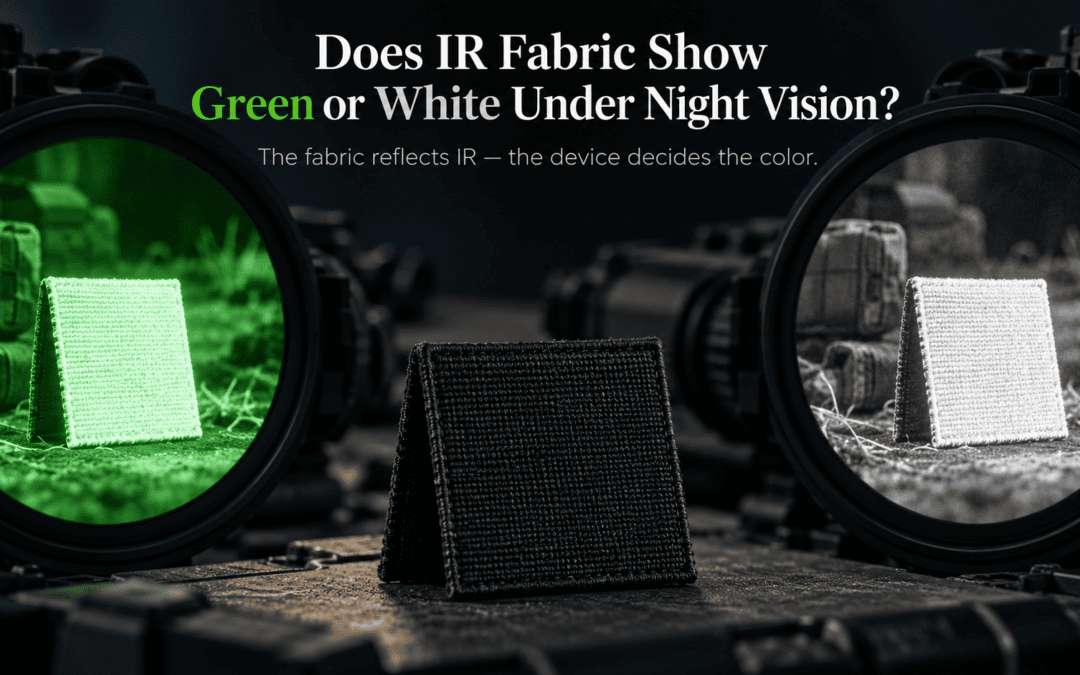
We often get asked whether our black IR fabric “reflects green” or “reflects white” under NVGs. The answer surprises a lot of people: the fabric doesn't decide the color. Your night vision device does.
Infrared light has no color
IR-reflective fabric like our NIR-compliant material is built to reflect near-infrared light, usually in the 850–940nm range. That's past the edge of human vision, so it has no color. To the naked eye the fabric looks like ordinary matte black. Under NVGs it shows up as a bright, high-contrast signature because it reflects much more IR than the background around it.
What the fabric gives you is brightness and contrast, not color.
The phosphor screen sets the color
An image-intensified night vision device turns incoming light into electrons, amplifies them, and then fires them at a phosphor screen that you look at through the eyepiece. That screen sets the color of everything you see:
- Green phosphor (P43/P22): The traditional NVG look. Everything appears in shades of green, so IR-reflective fabric shows up as a bright green-white area.
- White phosphor (P45): Common in newer military and high-end civilian tubes. The image is black and white, so the same fabric shows up as bright white.
- Digital night vision: The color depends on the display settings. Many units let you switch between green, white, and other palettes.
The same roll of fabric will look green through one device and white through another.
What matters when choosing IR fabric
Instead of asking about color, look at:
- Wavelength response. Make sure the fabric reflects strongly at the wavelengths your devices and IR illuminators use. Many devices are less sensitive at 940nm than at 850nm.
- Visible appearance. Matte black or the camouflage colorway you need, with no visible shine.
- Durability and compatibility. Things like base fabric weight (for example, Cordura 500D compatibility) and whether it can be laser cut.
- IR source. The fabric reflects IR, it doesn't make its own. It shows up best with an IR illuminator or under ambient night light.
The bottom line
If you need a green signature, use a green-phosphor device. If you need white, use white phosphor. Either way, the IR fabric does the same job: it gives a bright, reliable signature that stands out under night vision.
The Author: Tom Boyer

Since 2006, Tom has been the driving force behind IR.Tools, dedicated to delivering top-notch infrared solutions to the military, law enforcement, and sportsmen communities.
What began with a single infrared patch has blossomed into a comprehensive store featuring hundreds of IFF patches, vehicle IFF, an extensive suite of thermal training targets, and tools for drone pilots.
Beyond his innovative products, Tom is passionate about educating users on infrared technology and showcasing how advancements in IR can enhance their operations.
Tom holds an MS in Mechanical Engineering from the University of Maryland and an MBA from Regents University.